
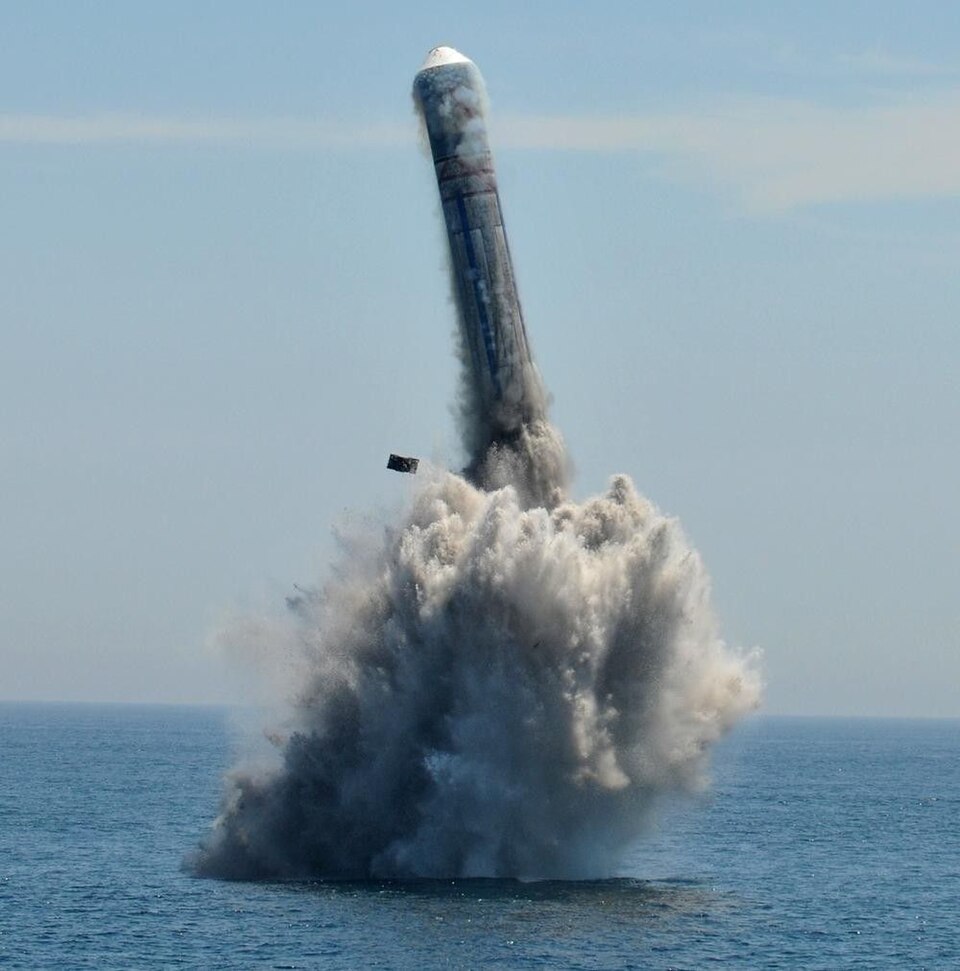
China Submarine Missile Test Signals Push For Credible Nuclear Triad
A Chinese ballistic-missile submarine launched a test missile with a dummy warhead into the South Pacific at 12:01 p.m. local time on Monday, July 6, 2026.[1]
New Zealand says it was informed only hours before the test.[2] Wellington also says the missile splashed down inside the South Pacific Nuclear Free Zone created by the 1986 Treaty of Rarotonga, which China ratified in 1987.[1] Australia's foreign minister Penny Wong called the launch destabilizing and said Australia conveyed that view directly to Beijing.[1] Japan's chief cabinet secretary Minoru Kihara and the defense ministry urged China to rethink testing that could fly over Japan or raise new security risks.[1] China's foreign ministry dismissed criticism and urged other countries not to overinterpret the exercise.[2]
China began flight-testing its JL-3 submarine-launched ballistic missile in November 2018, advancing integration with Jin-class ballistic-missile submarines through late 2019. New Zealand said the submarine launch followed a pattern after Beijing's September 2024 ICBM test into the Pacific.[1] The Pentagon estimated China held about 600 nuclear warheads in 2024 and projected more than 1,000 by 2030, while data show China operates six Jin-class ballistic-missile submarines.[1]
Initial regional coverage emphasized the test's location inside the South Pacific nuclear-free zone and the alarm it prompted in Australia, Japan and New Zealand.[1] By Tuesday the New York Times framed the launch as a signal from Xi Jinping that Beijing is sharpening sea-based nuclear forces to build a credible nuclear triad.[3]
Analysts called it the first publicly acknowledged submarine test of a dummy warhead that reached so far into the Pacific.[1] Chinese state media said the test gave the sea-based force "another upgrade" and touted its ability to carry out stable counterstrikes across the Pacific.[3]
The mainstream summary emphasizes the immediate regional reactions to China's missile test, particularly the concerns expressed by Australia, Japan, and New Zealand. However, it does not delve into the broader implications of this test for China's military strategy. Analysts suggest that this launch represents a significant advancement in China's sea-based nuclear deterrence capabilities, indicating a shift in regional power dynamics. While the summary mentions the test's location within the South Pacific Nuclear Free Zone, it overlooks the strategic rationale behind China's ongoing nuclear modernization, which aims to enhance its retaliatory capabilities against potential adversaries and elevate its status as a global military power. This context is crucial for understanding the motivations behind such military exercises and their potential impact on international relations.
Additionally, the Pentagon's projection of China's nuclear arsenal growth is noted, but the summary does not highlight the operational context driving this expansion. According to a 2025 analysis, China's nuclear modernization is influenced by a combination of factors, including the need to counter adversarial missile defenses and to maintain a credible deterrent against perceived threats. This multifaceted approach to nuclear strategy underscores the complexity of the situation, which is not fully captured in the mainstream account.[4]
Show source details & analysis (4 sources)
📊 Relevant Data
China operates six operational Jin-class (Type 094) ballistic-missile submarines.
China Submarine Capabilities — Nuclear Threat Initiative
📌 Key Facts
- A Chinese nuclear-powered ballistic missile submarine launched a ballistic missile into the South Pacific at 12:01 p.m. local time on Monday, July 6, 2026, and the flight carried a dummy warhead.
- New Zealand says it was informed only hours beforehand and that the missile splashed down inside the South Pacific Nuclear Free Zone created by the 1986 Treaty of Rarotonga, which China ratified in 1987.
- Australia’s Foreign Minister Penny Wong called the test destabilizing, said Australia communicated that view directly to China, and the launch coincided with the signing of a new Australia–Fiji mutual defense treaty intended to counter Chinese influence in the Pacific.
- Japan’s Chief Cabinet Secretary Minoru Kihara and the Defense Ministry urged China to rethink missile testing, warning that Beijing’s growing military activity and lack of transparency create new security risks.
- Analyst Lyle Morris said this was the first publicly acknowledged test of a dummy warhead from a Chinese ballistic-missile submarine that traveled this far into the Pacific and noted Japan, New Zealand and Australia received advance notifications while the United States did not.
- The nuclear triad — the New York Times reports — is the explicit focus of Xi Jinping’s messaging after the July 6 test, with state media saying China’s sea-based nuclear force has received “another upgrade.”
- Data cited by PBS indicates China operates six ballistic-missile submarines and 59 nuclear-powered attack submarines, and the Pentagon’s 2025 report estimated roughly 600 Chinese nuclear warheads in 2024 and projected more than 1,000 by 2030.
- A Chinese Foreign Ministry spokesperson dismissed regional criticism and urged countries not to overinterpret the test, while U.S. State Department spokesperson Thomas Pigott accused China of a rapid, opaque nuclear buildup that is a concern for the region and the world.
📰 Source Timeline (4)
Follow how coverage of this story developed over time
- The New York Times reports on July 7, 2026, that Chinese leader Xi Jinping is using the July 6 submarine-launched missile test to signal determination to build a full nuclear triad, with a particular focus on strengthening historically weak sea-based capabilities.
- Chinese party-run newspaper Global Times declared after the test that China’s nuclear triad had received “another upgrade” and claimed the People’s Liberation Army’s sea-based nuclear force is capable of carrying out “stable, reliable strategic counterstrikes from anywhere in the vast open seas of the Pacific Ocean.”
- Experts cited by the Times assess that the missile was likely launched from a Type 094 nuclear-powered ballistic-missile submarine operating off China’s coast and flew to waters near the Solomon Islands, and they describe the test as only the third time China has conducted a long-range missile flight across the Pacific.
- The article links the test to years of internal turmoil in the Chinese military, noting that the PLA has seen mass removals of commanders over corruption and disloyalty, yet the test is being presented domestically as evidence that nuclear modernization remains on track.
- Analysts quoted by the Times say the test shows Beijing shedding past reluctance to fire long-range missiles through international airspace and waters, accepting the scrutiny and alarm such demonstrations generate in order to advance undersea nuclear ambitions.
- NPR confirms the launch was at 12:01 p.m. local time Monday, July 6, 2026, from a Chinese nuclear-powered submarine in the South Pacific and that it carried a dummy warhead.
- New Zealand Foreign Minister Winston Peters told the Associated Press that Wellington was informed only hours before the test and emphasized that the missile splashed down inside the South Pacific Nuclear Free Zone created by the 1986 Treaty of Rarotonga.
- NPR adds that China ratified the Treaty of Rarotonga protocols in 1987, pledging not to test nuclear weapons or threaten nuclear use against states in the zone, and notes regional concern that the test still occurred within the zone.
- Australia’s Foreign Minister Penny Wong, speaking in Fiji, called the test destabilizing and said Australia had communicated that view directly to China.
- Japan’s Defense Ministry and Chief Cabinet Secretary Minoru Kihara publicly urged China to rethink its missile testing so that projectiles would not fly over Japan or create new security risks, citing Beijing’s growing military activity and lack of transparency.
- A Chinese Foreign Ministry spokesperson dismissed the criticism and urged “relevant countries” not to overinterpret the test.
- U.S. State Department spokesperson Thomas Pigott said the United States is working harder than ever to prevent nuclear proliferation while accusing China of a rapid and opaque nuclear weapons buildup and calling the buildup a concern for the region and the world.
- NPR notes that the test coincided with the signing of a new mutual defense treaty between Australia and Fiji intended to counter Chinese influence in the Pacific, sharpening the political context of regional reactions.
- Article confirms the launch occurred Monday, July 6, 2026, at 12:01 p.m. local time from a Chinese nuclear-powered ballistic missile submarine in the South Pacific.
- New Zealand says it was informed only hours beforehand and emphasizes that the missile splashed down inside the South Pacific Nuclear Free Zone created by the 1986 Treaty of Rarotonga, which China ratified in 1987.
- Australian Foreign Minister Penny Wong, speaking in Fiji the same day, said Australia had told China it regards the test as destabilizing to the region.
- Japan's Defense Ministry and Chief Cabinet Secretary Minoru Kihara publicly urged China to rethink its missile testing and cited China's lack of transparency and growing military activity as a grave concern.
- Analyst Lyle Morris is quoted saying this is the first publicly acknowledged test of a dummy warhead from a Chinese nuclear ballistic missile submarine that traveled this far into the Pacific and notes that Japan, New Zealand and Australia received advance notifications but the U.S. did not.
- Analyst Drew Thompson attributes regional concern partly to China's military buildup occurring without increased openness, creating uncertainty about intentions.
- The article cites Nuclear Threat Initiative data that China operates six ballistic-missile submarines and 59 nuclear-powered attack submarines.
- It reiterates the Pentagon's 2025 report to Congress estimating China's 2024 nuclear warhead stockpile at around 600 and projecting more than 1,000 warheads by 2030.