
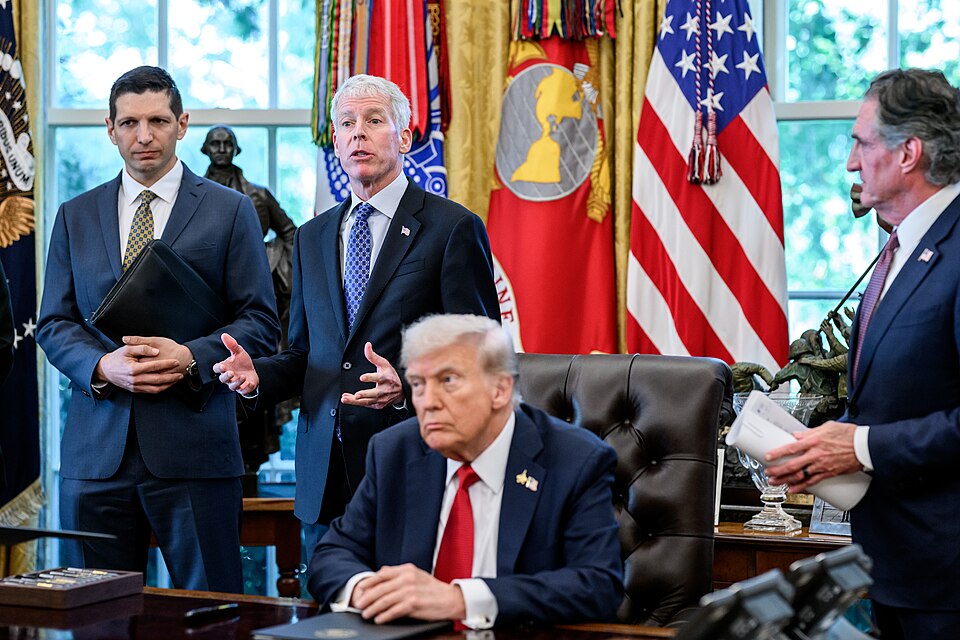
Trump Fires All Election Assistance Commissioners, Crippling Agency Before Midterms
On Thursday, July 9, 2026, President Donald Trump dismissed the remaining members of the U.S. Election Assistance Commission, leaving the agency without commissioners just months before the November midterms.[1]
Democratic commissioners Thomas Hicks and Benjamin Hovland were terminated, Republican Christy McCormick resigned, and Republican Donald Palmer had departed earlier this year.[2] The White House said Trump "reserves the right to remove individuals that may not be totally aligned" with his election-security priorities and explicitly cited the Supreme Court's Trump v. Slaughter decision as precedent.[2]
On March 25, 2025, Trump signed an executive order directing the EAC to add proof-of-citizenship requirements to the federal voter registration form and to condition grants on state compliance; judges have blocked the main provisions as exceeding presidential authority.[2] Republican commissioner Donald Palmer announced his departure effective April 29, 2026, leaving three commissioners before Thursday's removals.[2] The White House and multiple outlets say the administration relied on the June 29 Supreme Court ruling in Trump v. Slaughter to justify removing for-cause protections for agency appointees.[1]
Current and former EAC officials say the sudden vacancies stop work that requires a three-member quorum, including voting-system guideline updates, testing and certification of equipment, and grant actions.[1] Sen. Alex Padilla and Rep. Joe Morelle called the removals an effort to politicize elections and to dismantle an "independent guardrail" of democracy.[3] Brennan Center president Michael Waldman warned the move leaves the EAC "without leadership and unable to carry out its major responsibilities." NPR Arizona Secretary of State Adrian Fontes called the action "irresponsible and dangerous" but said state and local election officials "have this" for November.[4]
Early reports emphasized immediate operational chaos and risks to election preparations.[5] Later coverage has framed the firings as part of a broader, strategic push by Trump to reshape control over voting processes and to test the scope of presidential authority over independent agencies.[3]
The mainstream summary does not fully capture the operational implications of the EAC's leadership vacuum. Halina Bennet argues that the firings are not merely a political maneuver but a significant blow to the agency's ability to function effectively, halting essential activities like guideline updates and grant administration that local jurisdictions depend on for election integrity. This perspective highlights a critical operational uncertainty that the mainstream coverage downplays, emphasizing that the removals create a chaotic environment just months before the midterms, which could undermine public trust in the electoral process. Furthermore, the summary mentions the Supreme Court's ruling as a justification for the firings, but it does not delve into the broader implications of this decision, which Bennet suggests signals a troubling departure from norms that protect independent agency operations and could lead to increased politicization of election infrastructure tasks.
Additionally, while the mainstream account notes that the EAC has operated without a quorum before, it fails to mention that historically, this has occurred for about 18% of its existence, indicating that while the agency can function under certain conditions, the current context—amid a politically charged environment—could exacerbate the risks to election preparedness and integrity. The urgency of the situation is underscored by the Brennan Center's warning that the EAC is now 'without leadership' and unable to fulfill its responsibilities, a point that underscores the gravity of the administration's actions beyond what was presented in the mainstream narrative.[6][7][2]
Show source details & analysis (7 sources)
📊 Relevant Data
The Help America Vote Act requires an affirmative vote by at least three of the EAC's four commissioners to conduct official business, establish policy, update voting system guidelines, or hire an executive director.
What is the Election Assistance Commission With No Commissioners? — Just Security
The EAC has operated without a quorum for approximately 18% of its existence (about 1 out of every 5 days since 2002) and has previously functioned for extended periods with zero or fewer than three commissioners.
The Election Assistance Commission Has a Vacancy. Now What? — Bipartisan Policy Center
The EAC's requested FY2027 budget is $23.86 million with 68 full-time equivalent staff positions.
EAC FY2027 Congressional Budget Justification Report — U.S. Election Assistance Commission
📌 Key Facts
- On Thursday, July 9, 2026, President Trump dismissed the remaining members of the U.S. Election Assistance Commission, leaving the agency without commissioners and unable to act as a bipartisan federal body (President Trump).
- The departures left Democratic commissioners Thomas Hicks and Benjamin Hovland terminated, Republican commissioner Christy McCormick resigned, and Republican Donald Palmer had already left earlier in 2026 (Thomas Hicks and Benjamin Hovland).
- A White House statement said Trump “reserves the right to remove individuals that may not be totally aligned” with his election-security priorities and explicitly relied on the Supreme Court’s Trump v. Slaughter ruling as precedent (White House statement).
- Current and former EAC officials and legal experts warned the sudden vacancies halt key EAC work that requires a quorum—pending voting-system guideline updates, testing and certification of new equipment, and grant actions—which could complicate preparations for the November 2026 midterms (voting-system guideline updates).
- The EAC had declined to change the national voter-registration form to require documentary proof of citizenship; Trump’s March 2025 executive order to add such requirements has been blocked by judges as exceeding presidential authority (March 2025 executive order).
- Sen. Alex Padilla and Rep. Joe Morelle, the ranking Democrats on congressional election-oversight panels, said the removals amount to politicizing elections and dismantling an “independent guardrail” of democracy (Sen. Alex Padilla and Rep. Joe Morelle).
- Arizona Secretary of State Adrian Fontes called the move “irresponsible and dangerous,” warned it undermines nonpartisan election administration and public confidence, but said state and local election officials remain prepared for the midterms (Arizona Secretary of State Adrian Fontes).
- Legal analysts cautioned the Slaughter decision’s reasoning could extend removal authority across other independent agencies, while a separate court decision carved a narrow exception for the Federal Reserve (Slaughter decision).
📊 Analysis & Commentary (2)
"The author criticizes President Trump's removal of the Election Assistance Commission commissioners, arguing the purge is political theater that nonetheless inflicts real operational damage on a small but vital bipartisan agency — undermining election‑administration capacity and public trust even if the White House has the legal authority to replace commissioners."
"Gigot treats the Michigan El‑Sayed–Stevens contest as a key test of the Democratic left and warns that President Trump’s removal of the Election Assistance Commission leaders is a consequential, institution‑shaking action ahead of the midterms (i.e., he is skeptical of the left’s prospects and concerned about the erosion of bipartisan election oversight)."
📰 Source Timeline (7)
Follow how coverage of this story developed over time
- PBS segment on July 10, 2026, emphasizes that the firings come while planning for the November 2026 midterm elections is already well underway.
- The report underscores that the Election Assistance Commission helps state and local officials run smooth elections and certify voting equipment, and that Trump removed the remaining members of this bipartisan federal agency.
- PBS frames the move explicitly as part of a continuing attempt by Trump to control the voting process, highlighting concerns about how the loss of commissioners could affect election administration this November.
- PBS/AP confirms on Friday, July 10, 2026, that President Trump removed Democratic commissioners Thomas Hicks and Benjamin Hovland, while Republican Christy McCormick resigned and former commissioner Donald Palmer had previously left, leaving the Election Assistance Commission without members.
- The White House statement explicitly ties the removals to the Supreme Court’s recent Trump v. Slaughter decision, saying the ruling gives the president precedent to remove independent-agency appointees who are not "totally aligned" with his election-security priorities.
- The article notes the EAC had previously declined to change the national voter registration form to require documentary proof of citizenship, a position at odds with Trump’s March 2025 executive order on elections that courts have blocked as exceeding presidential authority.
- Sen. Alex Padilla and Rep. Joe Morelle, the ranking Democrats with congressional election-oversight roles, publicly accuse Trump of dismantling an "independent guardrail" of democracy and warn that purging commissioners months before midterms is part of a plan to politicize elections.
- Legal experts cited in the piece highlight that the Slaughter decision’s reasoning extends beyond the EAC to other independent agencies, while a separate decision involving Fed Governor Lisa Cook carved out a narrow exception for the Federal Reserve.
- The article underscores uncertainty over whether Trump will nominate replacement commissioners, warning that vacancies could impede EAC grant distribution and voting-system testing and certification ahead of the November 2026 midterms.
- On July 10, 2026, Arizona Secretary of State Adrian Fontes criticized Trump's July 9 removals of the final EAC commissioners in an interview on MS NOW's "The Briefing."
- Fontes described the EAC as a "bipartisan partner" that helps election administrators set technical standards, coordinate messaging, and share data, and warned its loss so close to November is "so bad" for elections.
- He said the main impact will be on the stability and consistency that EAC expertise provides, arguing that "swooping them away" also undermines public confidence in election administration.
- Fontes nonetheless told voters that state and local election officials "have this" for the upcoming midterms and emphasized that most operational preparations are already in place.
- The New York Times confirms that President Trump personally approved the July 9, 2026 removal of the remaining U.S. Election Assistance Commission members and that the White House relied on the Supreme Court’s Trump v. Slaughter ruling to justify the move.
- The article adds internal reaction detail: current and former EAC officials describe specific halted work streams, including pending voting-system guideline updates and grant actions that now cannot proceed without a quorum.
- The Times reports additional reaction from election officials and legal experts warning that the sudden vacancies could complicate certification of new voting equipment for the 2026 midterms, especially in smaller jurisdictions that rely heavily on EAC guidance.
- On Thursday, July 9, 2026, an association of state election officials notified its members that President Trump had dismissed the remaining U.S. Election Assistance Commission members.
- A White House statement said Trump "reserves the right to remove individuals that may not be totally aligned" with his election-security priorities and explicitly cited the Supreme Court's recent Slaughter decision as precedent.
- The article specifies that Republican commissioner Don Palmer had already departed earlier in 2026, and that Trump then dismissed Democratic commissioners Thomas Hicks and Benjamin Hovland while Republican Christy McCormick resigned.
- NPR notes that the main provisions of Trump's 2025 executive order directing the EAC to add proof-of-citizenship requirements to the federal voter registration form have been blocked by judges as exceeding presidential authority.
- Sen. Alex Padilla and Rep. Joe Morelle, the ranking Democrats on key election committees, issued a joint statement calling the removals an effort to "politicize our elections and enable more unlawful and dangerous election interference."
- Brennan Center president Michael Waldman warned that removing all commissioners leaves the EAC "without leadership and unable to carry out its major responsibilities."
- The piece reiterates that all three removed or departed commissioners had previously been unanimously confirmed by the Senate under the Help America Vote Act's bipartisan structure.
- The Guardian article reiterates that on Thursday, July 9, 2026, President Donald Trump forced out the remaining three Election Assistance Commission members, with the one Republican resigning and the two Democratic commissioners receiving immediate termination emails from the White House presidential personnel office.
- The piece quotes Arizona Secretary of State Adrian Fontes calling the move "irresponsible and dangerous" and saying it "undermines the integrity of nonpartisan election administration."
- The article restates that under the 2002 Help America Vote Act, the president can appoint replacement commissioners, but notes it is unclear how Trump will proceed.