
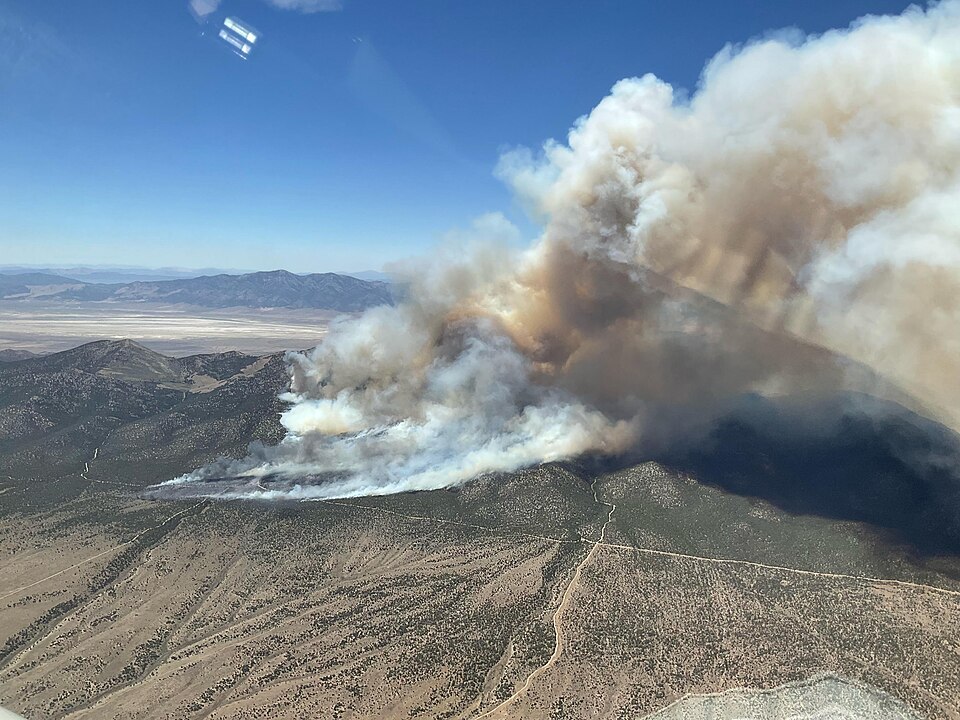
Hawk Fire Near Reno Slows As Residents Return While New Texas Blaze Grows
Firefighters had largely halted the Hawk Fire near Reno on Tuesday, and thousands of residents began returning even as more than 20,000 people remained unable to go home.[1]
The blaze has scorched roughly 15,000 acres and was about 27% contained as of Tuesday, officials said.[2] The fire has destroyed more than 30 homes and injured seven people, including three first responders.[2] Authorities ordered about 42,000 residents to evacuate and placed roughly 45,000 more under warnings as the zone reached the edge of the University of Nevada, Reno campus.[3] Gov. Joe Lombardo declared a state of emergency and mobilized the Nevada National Guard with helicopter crews and troops, and the Reno-Sparks Convention Center served as a primary shelter.[3] Nearly 10,000 customers remained without power, portions of U.S. Route 395 were closed, and two Northern Nevada medical centers evacuated patients and stayed closed.[4]
The blaze began late Saturday near the Sierra Nevada foothills and raced into the Peavine Peak area, growing quickly over the weekend.[3] Truckee Meadows Fire Protection District battalion chief Shane Akerson said investigators confirmed the fire was human-caused but had not determined whether the activity was intentional or accidental.[3] On Sunday the blaze moved so fast it jumped over fire trucks and displayed extreme behavior that pushed flames toward neighborhoods, forcing rapid evacuations.[5] More than 750 public safety personnel were assigned at the fire's peak as crews battled drought-driven fuels and shifting winds.[4]
Early coverage noted only that the fire was human-caused; later reporting emphasized that officials had not established whether the ignition was accidental or deliberate, refining earlier ambiguity in public statements.[6] As Nevada crews steadied, a separate wildfire in rural Texas mushroomed on Tuesday and prompted new evacuation orders there.[2] Federal data underscore a severe 2026 season, with more than 7.7 million acres burned nationwide so far this year.[3]
Show source details & analysis (14 sources)
📌 Key Facts
- Truckee Meadows Fire Protection District battalion chief Shane Akerson said the blaze was confirmed to be human-caused, though investigators had not yet determined whether it was intentional or accidental (Truckee Meadows Fire Protection District battalion chief Shane Akerson).
- As of Tuesday, August 25, 2026 the Hawk Fire had burned roughly 15,000+ acres (about 23 square miles / ~60 sq km), was reported about 27% contained, and officials said the blaze had destroyed more than 30 homes (27% containment).
- Authorities ordered about 42,000 residents to evacuate under mandatory “GO NOW” orders and placed roughly 45,000 more under evacuation warnings (about 90,000 people total); the expanded evacuation zone reached the edge of the University of Nevada, Reno campus (University of Nevada, Reno campus).
- Officials reported at least seven people — three first responders and four civilians — had been injured in the Hawk Fire as of the latest updates (seven people).
- Nevada Gov. Joe Lombardo declared a state of emergency for Washoe County and mobilized the Nevada National Guard to provide two helicopter crews and about 60 troops to assist with aerial firefighting and to secure evacuated neighborhoods (Gov. Joe Lombardo).
- Washoe County opened the Reno-Sparks Convention Center as a primary shelter (with separate facilities for small and large animals) while nearly 10,000 customers remained without power (down from roughly 60,000), portions of U.S. Route 395 were closed, and two Northern Nevada Health System medical centers evacuated patients and remained closed (Reno-Sparks Convention Center).
- By Tuesday, August 25, 2026 firefighters had largely halted the fire’s advance and thousands of residents began returning, though more than 20,000 people still could not return home and some local schools remained closed (residents near Reno).
- Officials and federal data framed the blaze within an intense 2026 wildfire season: National Interagency Fire Center data put the year-to-date burned area across the U.S. at more than 7.7 million acres (National Interagency Fire Center).
📰 Source Timeline (14)
Follow how coverage of this story developed over time
- As of Tuesday, August 25, 2026, the Hawk Fire in Nevada was reported at 27% containment.
- Nevada authorities said at least seven people — three first responders and four civilians — have been injured in the Hawk Fire.
- Officials reiterated that the Hawk Fire has destroyed more than 30 homes across about 23 square miles (60 square kilometers).
- Fire officials in Reno said they believe the Hawk Fire was caused by human activity, either intentional or accidental.
- By Monday morning, August 24, 2026, local authorities learned firefighters had largely stopped the Hawk Fire from advancing.
- Thousands of residents near Reno, Nevada began returning to their homes by Tuesday, August 25, 2026, after earlier mass evacuations.
- Officials said the Hawk Fire was "practically halted" as of August 25, 2026, though several people were injured and dozens of homes had already burned.
- The blaze has burned more than 15,000 acres since it began on Saturday, August 22, 2026, near the base of the Sierra Nevada.
- Officials said the fire was probably sparked by human activity near the foothills of the Sierra Nevada.
- More than 800 public safety personnel were deployed on Sunday, August 23, 2026, when the fire was moving rapidly toward Reno with zero containment.
- The CBS segment published at 8:09 a.m. Central on Tuesday, August 25, 2026, reports that the Hawk Fire has 'exploded in size,' reinforcing that fire growth continued into Tuesday morning.
- CBS correspondent Jason Allen reports that 'thousands' have been forced to evacuate from Reno, Nevada, reiterating the scale of ongoing evacuations on August 25, 2026.
- The article confirms that televised coverage is now focused on the human impact of evacuations from Reno neighborhoods as the fire spreads.
- As of Tuesday, August 25, 2026, firefighters in Nevada are working to contain the Hawk Fire near Reno.
- More than 20,000 residents are still unable to return home as of August 25, 2026, due to the Hawk Fire.
- Schools in the affected Reno-area communities remain closed on August 25, 2026, because of the wildfire.
- CBS reports that other wildfires continue to burn in parts of the western United States at the same time, though it does not specify locations in this segment.
- On Monday, August 24, 2026, CBS reported that firefighters are continuing work to contain the Hawk Fire near Reno, Nevada, with efforts challenged by drought conditions and high winds.
- The CBS segment emphasizes that ongoing drought and gusty winds are actively fueling the Hawk Fire's spread and complicating suppression operations.
- CBS correspondent Jason Allen provided on-the-ground coverage of smoke and flame conditions near Reno as crews attempt to strengthen fire lines.
- The New York Times piece, published Monday, August 24, 2026, reports the Hawk Fire at more than 15,000 acres burned as of Sunday evening, August 23, 2026, while officials still described zero containment.
- Local officials said about 45,000 people had been ordered to evacuate and an additional 40,000 were under warnings that they might need to leave on short notice as of Sunday, August 23, 2026.
- Roughly 10,000 customers remained without power by Sunday night, down from about 60,000 without electricity on Saturday, August 22, 2026.
- Six people, including three firefighters, had been injured by the Hawk Fire as of Sunday evening; officials had not yet determined how many structures were damaged or destroyed.
- State officials said the Hawk Fire is human-caused but have not indicated whether they suspect arson.
- Gov. Joe Lombardo declared an emergency in the region and warned on Sunday that the fire remained a rapidly evolving situation.
- More than 750 firefighting personnel were working the fire as of Sunday evening, not counting National Guard troops and local police assisting with neighborhood security.
- Two Northern Nevada Health System medical centers evacuated patients and remained closed on Monday, August 24, 2026, because of the fire threat and conditions.
- Forecasts in the article describe smoke from the Hawk Fire worsening air quality in the Reno area on Monday, August 24, 2026, with light morning winds allowing smoke to settle and stronger afternoon winds expected to both disperse smoke and complicate firefighting.
- The article situates the Hawk Fire within a broader 2026 Western wildfire season, citing more than 400,000 acres burned in Washington state and a record 2.4 million acres burned in Oregon.
- Article confirms that as of Sunday, August 23, 2026, the Hawk Fire in northwest Reno had destroyed multiple homes, including at least one detailed household account.
- Officials reiterated that the Hawk Fire is human-caused but still have not disclosed whether it was intentional or accidental or how they reached that conclusion.
- Authorities said some 42,000 residents were under mandatory "GO NOW" evacuation orders and an additional 45,000 people were in an evacuation warning zone reaching the edge of the University of Nevada, and urged people to be prepared to stay away for several days.
- A Sunday evening, August 23, 2026 incident update warned firefighters observed extreme fire behavior with gusts pushing flames through dry brush and forecast moderate-to-high intensity runs over the next 12 hours.
- Nevada Gov. Joe Lombardo declared a state of emergency in Washoe County and mobilized the Nevada National Guard with two helicopter crews for aerial firefighting support.
- Washoe County Sheriff Darin Balaam publicly urged residents on Sunday, August 23, 2026, to leave immediately, citing shifting winds and the fire's rapid advance through neighborhoods.
- By Sunday, August 23, 2026, the Hawk Fire had grown to more than 23 square miles with zero containment reported.
- Authorities said about 42,000 residents were under mandatory evacuation orders and roughly 45,000 more were in an evacuation warning zone, for a total of about 90,000 people affected.
- Officials reiterated that the Hawk Fire is human-caused but did not specify whether it was intentional or accidental.
- At least six people, including three first responders and three civilians, were injured as of Sunday, August 23, 2026.
- Nevada Gov. Joe Lombardo declared a state of emergency in Washoe County and mobilized the Nevada National Guard to support aerial firefighting with two helicopter crews and 60 troops to help secure evacuated neighborhoods.
- Nearly 10,000 customers in Washoe County were without power on Sunday, August 23, down from about 60,000 on Saturday, August 22, 2026.
- Portions of U.S. Route 395, a major north–south highway, were closed due to the Hawk Fire.
- The expanded "GO NOW" evacuation zone reached the edge of the University of Nevada campus in Reno, and officials warned residents they may need to stay away for several days as winds strengthen.
- Incident updates Sunday evening reported "extreme fire behavior" with gusts pushing flames through dry brush and forecasts of moderate to high-intensity runs over the next 12 hours.
- NPR reports Sunday, August 23, 2026, that the Hawk Fire had grown to more than 15,000 acres (about 23.4 square miles) since it began late Saturday morning, August 22, 2026, in the Sierra Nevada foothills.
- Officials said roughly 42,000 Reno-area residents were under mandatory evacuation orders and another 45,000 were told to prepare to evacuate on Sunday, confirming the scale of prior estimates.
- Truckee Meadows Fire Protection District battalion chief and incident commander Shane Akerson said at a Sunday morning press conference the Hawk Fire was confirmed to be human-caused, though the cause remains under active investigation.
- Akerson said at least six people, including three civilians and three first responders, had been injured, and that several properties had been destroyed as of Sunday.
- Authorities said about 800 emergency responders were assigned to the Hawk Fire on Sunday, August 23, 2026.
- The "go now" evacuation zone on Sunday extended to the edge of the University of Nevada, Reno campus, and officials warned evacuees they might be unable to return home for several days due to shifting winds.
- Gov. Joe Lombardo's state of emergency for Washoe County and National Guard activation were described as unlocking federal resources to help contain the fire.
- Washoe County Sheriff Darin Balaam publicly urged residents in warning zones to leave early if possible and recommended using the Watch Duty app and website for real-time wildfire information.
- The Reno-Sparks Convention Center was identified as a primary shelter, where local station KUNR reported hundreds of evacuees spent Saturday night, August 22, 2026.
- NPR added comparative context that the Hawk Fire is the third major northern Nevada wildfire in recent weeks, following the Bug Fire (nearly 94,000 acres, about 94% contained) and the Stallion Fire (just over 40,000 acres, about 98% contained).
- National Interagency Fire Center data cited in the article said more than 7.7 million acres had burned across the U.S. so far in 2026, the largest year-to-date burned area in a decade.
- CBS reports on Sunday, August 23, 2026, that thousands of people have been evacuated in Reno, Nevada, as the Hawk Fire closes in on the city.
- The CBS segment says the Hawk Fire has grown to 13,000 acres and is threatening hundreds of homes near Reno.
- CBS adds that at least 200 new wildfires have erupted nationwide over the same weekend, broadening the scope beyond Nevada.
- CBS video report on August 23, 2026 reiterates that as the Hawk Fire encroached on Reno on Sunday, around 90,000 people were forced to evacuate or were under evacuation orders and warnings.
- The segment states that officials believe the Hawk Fire is human-caused and notes Gov. Joe Lombardo has declared a state of emergency in part of Nevada, aligning with earlier print coverage.
- The piece adds current-day visual confirmation of fire behavior around Reno and active firefighting efforts as of Sunday, August 23, 2026, but does not update acreage, injury counts, or other quantitative metrics beyond what is already reported.
- Article confirms on Sunday, August 23, 2026, that the Hawk Fire is uncontained and has burned about 20 square miles (roughly 13,000 acres) in the Peavine Peak area of the Humboldt–Toiyabe National Forest.
- Washoe County Sheriff Darin Balaam said the fire on Saturday night, August 22, 2026, moved so fast it jumped over fire trucks, with shifting winds making it difficult for responders to reach hotspots while residents tried to evacuate.
- Officials reiterated that at least six people were injured in the Hawk Fire, including three civilians and three first responders, and said several structures were destroyed.
- Authorities said some 42,000 residents have been ordered to evacuate in the "GO NOW" zone, which now reaches the edge of the University of Nevada, Reno campus, and an additional 45,000 people are in an evacuation warning zone.
- Gov. Joe Lombardo declared a state of emergency in Washoe County and mobilized the Nevada National Guard to provide two helicopter crews for aerial firefighting and 60 troops to help secure evacuated neighborhoods.
- Officials reported that nearly 10,000 customers in Washoe County remained without power on Sunday, August 23, down from about 60,000 on Saturday, August 22, and that portions of U.S. Route 395 were closed.
- Washoe County emergency officials opened the Reno-Sparks Convention Center as an evacuation shelter, while separate locations were designated for small and large animals, and local casinos offered discounted hotel rooms to evacuees.
- A first-person account from evacuee Cari Kieffer describes racing with her husband and four children to rescue their dogs and grab possessions as ash fell and flames advanced toward their northwest Reno neighborhood on Saturday, August 22; a later video showed their home completely destroyed, with only a burned basketball hoop remaining.
- Officials said Sunday, August 23, 2026 that the Hawk Fire is human-caused, though the exact ignition source remains under investigation.
- By Sunday, August 23, 2026 the Hawk Fire had grown to about 20 square miles (53 square kilometers) across the Peavine Peak area of the Humboldt–Toiyabe National Forest.
- Authorities said some 42,000 residents were under mandatory "GO NOW" evacuation orders and another 45,000 people were in an evacuation warning zone, meaning roughly 90,000 people were directed to leave or be ready to leave.
- At least six people had been injured as of Sunday, including three civilians and three first responders.
- Gov. Joe Lombardo's emergency declaration for Washoe County included mobilizing the Nevada National Guard to provide two firefighting helicopter crews and about 60 troops to help secure evacuated neighborhoods.
- Nearly 10,000 power customers in Washoe County were without electricity Sunday, down from about 60,000 on Saturday, and portions of U.S. Route 395 were closed due to the fire.
- Officials said about 800 firefighting personnel were assigned to the incident, and Washoe County opened the Reno-Sparks Convention Center as a shelter for evacuees, with separate locations designated for small and large animals.
- The expanded "GO NOW" zone reached the edge of the University of Nevada, Reno campus, and two hospitals had already evacuated patients while the sheriff monitored whether to evacuate the county jail.