
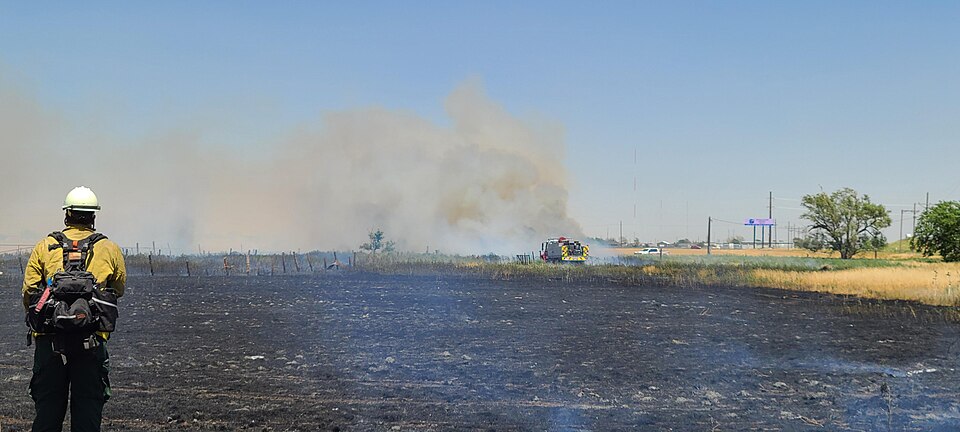
Ross Fire Grows Past 80,000 Acres As North Texas Evacuations Expand
By Thursday, August 27, 2026, the Ross Fire in Palo Pinto and Jack counties had burned more than 80,000 acres and was 21% contained, forcing new evacuations and road closures.[1]
Residents along County Road 2210 toward Highway 281 were ordered to evacuate, and an evacuation center opened at Twin Lake Recreation Center in Jacksboro.[2] Jacksboro ISD delayed the start of school by two hours while Perrin CISD canceled classes because of the wildfire and evacuations.[2] U.S. Highway 180 was closed between South FM 4 and FM 919, and a Temporary Flight Restriction was imposed over the fire area.[2] Worth Ranch suffered catastrophic damage to many buildings, though no scouts or guests were present and the camp ranger was safely evacuated.[2] A livestock holding station opened at the Old Mineral Wells Sale Barn to shelter displaced animals.[2]
The Ross Fire ignited on the afternoon of August 24 near U.S. Highway 180 in Palo Pinto County under elevated fire conditions. More than a month without measurable rainfall left grass and brush critically dry, and southwest winds gusting to about 20 mph helped the fire spread rapidly.[2]
Early reports on Tuesday, August 25 put the fire at about 50,000 acres and 8% contained.[2] Two days later officials said the blaze topped 80,000 acres and containment had risen to 21%.[1] The Ross Fire is now the second-largest wildfire on record in the National Weather Service Fort Worth warning area. Online trackers and social posts have shown higher acreage estimates and lower containment figures, reflecting ongoing uncertainty in a fast-moving wildfire.
The mainstream summary notes that the Ross Fire is the second-largest wildfire in the National Weather Service Fort Worth warning area but does not emphasize the broader context of the drought conditions affecting the region. As of August 25, 2026, 57.4% of Texas was experiencing drought conditions, which included abnormally dry areas across Palo Pinto and Jack counties, contributing significantly to the fire's rapid spread and intensity. This critical detail highlights the environmental factors that exacerbate wildfire risks, a nuance that the mainstream account overlooks. Furthermore, while the summary mentions the fire's growth to over 80,000 acres, reports from social media and local sources indicate that the fire's size has escalated to 87,900 acres with only 12% containment, reflecting ongoing challenges in managing the blaze and the urgency of the situation.
Additionally, the mainstream narrative frames the fire's development primarily through immediate impacts like evacuations and road closures, but it misses the systemic issues at play. Research indicates that increasing population growth, changing land use, and climate change are driving more intense fire seasons in Texas. NASA scientists have linked these trends to human-caused climate change, which has intensified fire weather patterns. These underlying factors are essential for understanding the increasing frequency and severity of wildfires in the region, providing a broader perspective that the mainstream summary does not fully capture.
Show source details & analysis (3 sources)
📊 Relevant Data
The Ross Fire is the second-largest wildfire in the National Weather Service Fort Worth warning area's recorded history.
Ross Fire holding at 85,000 acres in North Texas Thursday — Fort Worth Star-Telegram
As of August 25, 2026, 57.4% of Texas was in drought (D1-D4 categories on the U.S. Drought Monitor), including abnormally dry conditions across most of Palo Pinto and Jack counties.
Texas | Drought.gov — Drought.gov
📌 Key Facts
- As of Thursday, August 27, 2026, the Ross Fire had burned more than 80,000 acres after three days and was still actively burning.
- Containment of the Ross Fire was reported at only 21% containment as of Thursday, August 27, 2026.
- As of Tuesday, August 25, 2026, the Ross Fire had grown to at least 50,000 acres in Palo Pinto and Jack counties and was 8% contained.
- Residents in Jack County along County Road 2210 toward Highway 281 were ordered to evacuate, and an evacuation center was opened at Twin Lake Recreation Center on Highway 59 in Jacksboro.
- Jacksboro ISD delayed the start of school by two hours on Tuesday, August 25, 2026, while Perrin CISD canceled classes because of the wildfire and evacuations.
- U.S. Highway 180 was closed to all traffic between South FM 4 and FM 919, and a Temporary Flight Restriction was put in place over the fire area.
- The Longhorn Council of Scouting America reported catastrophic damage to many buildings at Worth Ranch in Palo Pinto County, though no scouts, campers, or guests were present and the camp ranger was safely evacuated.
- The Graham Livestock Commission opened a holding station for displaced livestock at the Old Mineral Wells Sale Barn, 2805 North Oak Ave, to shelter animals affected by the fire.
- CBS cited dry vegetation after more than a month without measurable rainfall and southwest winds gusting up to 20 mph as drivers of elevated wildfire risk west of Interstate 35.
📰 Source Timeline (3)
Follow how coverage of this story developed over time
- As of Thursday, August 27, 2026, the Ross Fire in North Texas has burned more than 80,000 acres after three days.
- Containment of the Ross Fire is reported at only 21% as of August 27, 2026.
- CBS notes the fire is still actively burning after three days, confirming it has not yet been brought under control.
- As of Tuesday afternoon, August 25, 2026, the Ross Fire had grown to at least 50,000 acres in Palo Pinto and Jack counties and was 8% contained, up from 78 square miles (about 49,000 acres) reported earlier.
- Residents in Jack County along County Road 2210 toward Highway 281 were ordered to evacuate, and an evacuation center was opened at Twin Lake Recreation Center on Highway 59 in Jacksboro.
- Jacksboro ISD delayed the start of school on Tuesday, August 25, 2026, by two hours, while Perrin CISD canceled classes due to the wildfire and evacuations.
- U.S. Highway 180 was closed to all traffic between South FM 4 and FM 919 because of the Ross Fire, and a Temporary Flight Restriction was put in place over the fire area.
- The Longhorn Council of Scouting America reported catastrophic damage to many buildings at Worth Ranch in Palo Pinto County, though no scouts, campers, or guests were present and the camp ranger was safely evacuated.
- The Graham Livestock Commission opened a holding station for displaced livestock at the Old Mineral Wells Sale Barn, 2805 North Oak Ave, to provide temporary shelter for animals affected by the fire.
- The article emphasizes that dry vegetation after more than a month without measurable rainfall and southwest winds gusting up to 20 mph are driving elevated wildfire risk west of Interstate 35 in North Texas.