
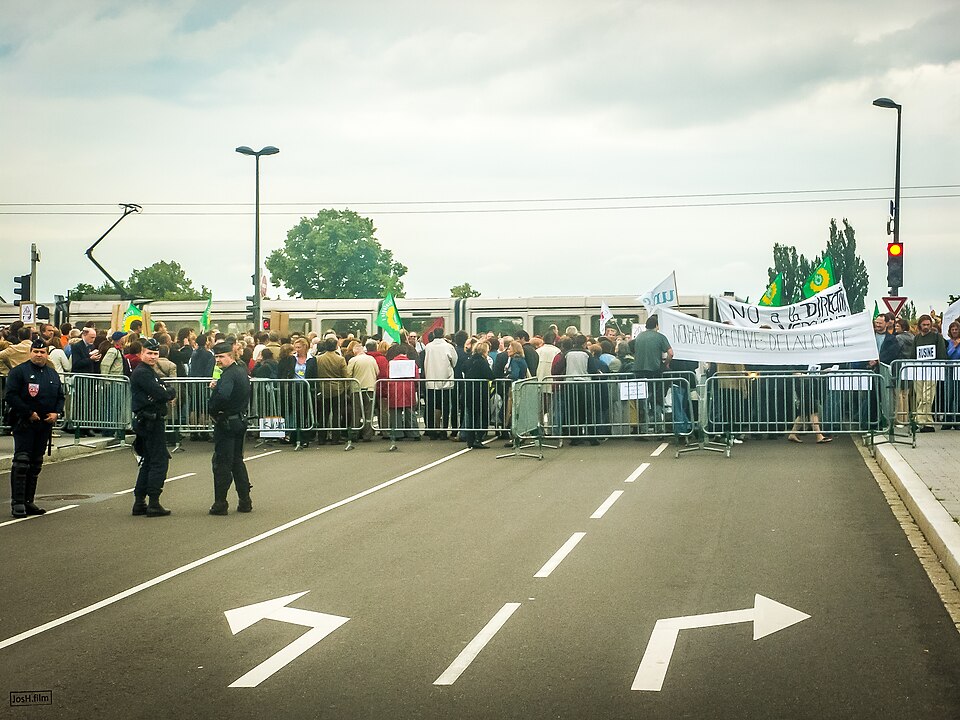
Macron Weighs State Of Emergency As France Reels From Cost-Of-Living Riots
France weighed a national state of emergency and ordered targeted curfews Monday as the government moved to quell violent cost-of-living riots across Paris, Lyon, Marseille and other cities.[1]
Authorities said at least 2,400 people were arrested over the weekend as groups set fires and looted businesses in Paris, Lyon and Marseille, while Interior Minister Laurent Nuñez offered his resignation, which President Emmanuel Macron refused.[2] Macron told Nuñez to ensure transparency about planning and intelligence failures and to quickly adopt new policing tactics.[2]
The unrest began weeks earlier with student protests over school conditions that then spread into nationwide demonstrations about rising living costs and public services, amplified by Yellow Vests organizers.[3] Mayors and local officials accused national police of failing to hold the line, with Marseille's mayor demanding compensation for damage after city hall was vandalized.[3]
Early reporting focused on curfew plans and riot control; later coverage shifted to frank ministerial admissions about intelligence and planning failures, changing the public debate toward accountability.[3] Paris police made 351 arrests on Sunday as sporadic looting persisted and university students blocked the Louvre entrance on Monday, forcing it to delay opening.[3]
The mainstream summary frames the unrest primarily as a response to rising living costs and public service issues, but it overlooks the broader political implications of the riots. Matt Goodwin argues that the violent unrest and the government's heavy-handed response expose political weaknesses that could benefit Marine Le Pen in the upcoming presidential election. He suggests that Macron's approach, characterized by mass arrests and bans on demonstrations, reinforces narratives of an out-of-touch establishment, which may lead to a consolidation of right-wing support among voters concerned about security and order. This perspective highlights a potential shift in the political landscape that the mainstream coverage does not address.
Additionally, while the summary mentions the arrests and curfews, it does not delve into the implications of these actions for public sentiment and political accountability. Goodwin points out that the government's response to the riots could be politically costly for Macron, as it may alienate voters who feel their concerns are not being adequately addressed. This context adds a layer of complexity to the situation that the mainstream summary simplifies, focusing instead on immediate events rather than the potential long-term consequences for France's political future.
Show source details & analysis (4 sources)
📌 Key Facts
- On Monday, October 19, 2026, Prime Minister Sébastien Lecornu said the government was prepared to impose a national state of emergency “if needed” and urged regional authorities to impose partial, localized curfews to protect businesses (Prime Minister Sébastien Lecornu).
- On Monday, October 19, 2026, Prime Minister Sébastien Lecornu said he had instructed prefects to impose very limited, localized curfews in French cities to prevent further rioting and looting, with specific areas to be detailed later the same day (Prime Minister Sébastien Lecornu).
- Interior Minister Laurent Nuñez offered his resignation on Sunday, October 18, 2026, but President Emmanuel Macron refused it, citing the need for continuity in law-enforcement leadership during the crisis (Interior Minister Laurent Nuñez).
- Laurent Nuñez publicly acknowledged on Monday, October 19, 2026, that authorities had “lost control” in some major cities, said police were underprepared for the scale of the weekend riots, and Macron directed him to ensure full transparency about failures in planning and intelligence and to introduce new policing tactics quickly (Laurent Nuñez).
- Authorities said at least 2,400 people were arrested across France over the weekend of October 17–18, 2026, as groups set fires and looted businesses in cities including Paris, Lyon, and Marseille (2,400 people).
- Paris police reported 351 arrests on Sunday, October 18, 2026, as sporadic violence and looting continued following Saturday’s major unrest (Paris police).
- The unrest caused significant heritage and municipal damage — including the burning of the 19th‑century Limoges town hall, fires at Lyon’s tourist office and vandalism of Marseille city hall — and university students blocked entrances to the Louvre on Monday, October 19, 2026 (Limoges town hall).
- Marseille Mayor Benoît Payan publicly accused the national government and police of “delivering” the city to looters, said the regional prefect had inflated rioter numbers, demanded “compensation down to the last cent” for damage, and authorities in Marseille imposed a citywide ban on gatherings from noon to 8 p.m. on Monday, October 19, 2026 (Marseille Mayor Benoît Payan) (Marseille Mayor Benoît Payan).
- The unrest began weeks earlier as protests by young people over school conditions before snowballing into national demonstrations against rising living costs and declining public services, with the Yellow Vests movement organizing rallies; Prime Minister Lecornu also blamed “an ultra-left movement” for attempting to orchestrate disorder ahead of the April presidential election (Yellow Vests movement).
- President Donald Trump weighed in via social media on Monday, October 19, 2026, claiming “The migrants have taken over France. They must CLOSE THE BORDERS, FAST!”, even though French officials have not linked the unrest to immigration (President Donald Trump).
📊 Analysis & Commentary (1)
"The author argues — in an opinion piece responding to the national unrest Macron condemned — that the violent protests, mass arrests and perceived government weakness will shift voters toward Marine Le Pen's law‑and‑order platform, making her the likely next president (while acknowledging the usual electoral caveats)."
📰 Source Timeline (4)
Follow how coverage of this story developed over time
- Over the weekend of October 17-18, 2026, widespread anti-government protests over cost of living and public services in many large French cities descended into riots, with nearly 2,500 people arrested nationwide by Saturday, October 17.
- Prime Minister Sébastien Lecornu said Monday, October 19, 2026, that the government is prepared to impose a national state of emergency 'if needed' and urged regional authorities to impose 'partial' and 'localized' curfews to protect businesses.
- Lecornu publicly blamed at least some of the violence on 'an ultra-left movement' that he said aims to orchestrate disorder leading up to the April presidential election and possibly challenge the holding of the vote.
- The unrest began weeks earlier as protests by young people over school conditions before snowballing into national demonstrations against rising living costs and declining public services, with the Yellow Vests movement organizing the rallies.
- Significant heritage damage occurred, including the burning of the 19th‑century Limoges town hall and fires at Lyon's tourist office and vandalism of Marseille city hall; protesters also blocked entrances to the Louvre Museum on Monday, October 19.
- President Donald Trump weighed in via social media on Monday, October 19, 2026, claiming 'The migrants have taken over France. They must CLOSE THE BORDERS, FAST!', even though French officials have not linked the unrest to immigration.
- On Monday, October 19, 2026, Prime Minister Sébastien Lecornu said he instructed prefects to impose very limited, localized curfews in French cities to prevent further rioting and looting, with specific areas to be detailed later the same day.
- Interior Minister Laurent Nuñez offered his resignation on Sunday, October 18, 2026, but President Emmanuel Macron refused it, citing the need for continuity in law-enforcement leadership during the crisis.
- Macron directed Nuñez to ensure full transparency about failures in planning and intelligence that allowed the violence and to introduce new policing tactics on the ground as quickly as possible.
- Authorities now say at least 2,400 people were arrested across France over the weekend of October 17–18, 2026, as groups set fires and looted businesses in cities including Paris, Lyon, and Marseille.
- Nuñez publicly acknowledged on October 19 that authorities had "lost control" in some major cities on Saturday and said police strategy must adapt to extremely mobile groups of troublemakers, looters, and far-left activists.
- On Monday, October 19, 2026, Interior Minister Laurent Nuñez told national radio that police were underprepared for the scale of the weekend riots that grew out of planned protests, and said he had offered his resignation to President Emmanuel Macron, which was not accepted.
- Justice Minister Gérald Darmanin said on French television that authorities had 'undeniably failed' in the face of the violence and that there had been 'a failure in intelligence.'
- Marseille Mayor Benoît Payan publicly accused the national government and police of 'delivering' the city to looters and rioters, said the regional prefect had inflated the number of rioters, and demanded 'compensation down to the last cent' for damage.
- Authorities in Marseille imposed a citywide ban on gatherings from noon to 8 p.m. on Monday, October 19, 2026, while officials in Denain, in northern France, announced a curfew from 9 p.m. to 9 a.m. through October 25, 2026.
- Paris police reported 351 arrests on Sunday, October 18, 2026, as sporadic violence and looting continued following Saturday's major unrest.
- The article notes that university students blocked entrances to the Louvre museum on the morning of Monday, October 19, 2026, preventing it from opening, as protests continued beyond the initial high-school-led movement.